

How to Start a Convenience Store in Japan as a Foreigner: The Complete 2026 Guide
 By Admin
Business & Money / Starting a business
Japan's convenience stores — known universally as konbini — are not just shops. They are an institution. There are more than 56,000 of them nationwide, open around the clock, generating a combined ¥13.5 trillion in annual sales. Japanese consumers visit a konbini on average 12 times a month. They pay utility bills there, pick up parcels, print documents, buy concert tickets, eat a freshly steamed nikuman at two in the morning, and wire money to a relative overseas — all at the same counter. No other retail format in the world serves its community quite the way a Japanese convenience store does.
Related inside
For a foreign entrepreneur considering a business in Japan, the konbini franchise model has an obvious surface appeal: established brand, loyal customer base, centralized supply chain, franchisor support, and a product that Japan's population genuinely cannot live without. The reality underneath that surface is considerably more nuanced — and more challenging — than the brochure suggests.
This guide covers the full picture. The visa requirements (which changed dramatically in October 2025), the franchise model and how it actually works in Japan, what the three major chains will expect of you, what the real financials look like, what it takes to operate independently, and the structural issues in the konbini market in 2026 that any serious potential franchisee must understand before signing anything.
The Konbini Market in 2026: Context Before Commitment
Understanding the current state of Japan's convenience store industry is not just background reading — it is essential due diligence for anyone considering entering this space.
Japan's konbini market reached genuine saturation years ago. The Japan Franchise Association counts more than 56,000 stores in a country of 125 million people — roughly one store for every 2,230 residents. In urban areas, the density is extraordinary: multiple competing chain stores often operate within a few hundred meters of each other. In some Tokyo neighborhoods, you can see three convenience stores from a single intersection.
The consequences of this saturation are being felt in the numbers that matter most to franchisees. Average annual income per convenience store franchise in Japan has fallen by approximately ¥2 million over the past five years as market penetration peaks and demographic decline in many areas reduces foot traffic. The annual number of convenience store bankruptcies has roughly doubled over the same period.
At the same time, the industry is investing heavily in its own reinvention. Seven-Eleven unveiled a 2030 store concept at Expo 2025 in Osaka featuring digital menu boards, self-ordering terminals, and in-store kitchens capable of producing made-to-order food. Lawson is pioneering retail media technology — digital signage that generates advertising revenue alongside product sales. FamilyMart is actively recruiting new franchisees, including those with no prior store experience, under a revised system launched in 2024. The industry is not dying; it is transforming.
For a foreign entrepreneur, the 2026 picture is this: the era of easy konbini profits from location alone is largely over. The franchisee who succeeds in this market today is one who manages their staff exceptionally well, embraces the technology tools the franchisor provides, maintains fanatical control over costs, and has both the financial cushion and the personal stamina to navigate a demanding operational reality. With those qualities, a well-located store can still generate solid, stable income. Without them, the math gets difficult fast.
Step 1: The Visa Question — Everything Starts Here

The most important decision for a foreign entrepreneur entering Japan's convenience store market is the visa question, and the October 2025 rule changes have made this more demanding than any previous guide describes.
Business Manager Visa — Post-October 2025 Requirements
The Business Manager Visa (経営・管理ビザ) is the primary visa pathway for foreign nationals who want to own and operate a franchise business in Japan. Since the dramatic revision that took effect on October 16, 2025, the requirements are substantially stricter than the previous framework that many older resources describe.
Current Business Manager Visa requirements (2026):
Capital of ¥30 million. The previous minimum of ¥5 million has been raised sixfold. This is equity capital that funds your business — not a refundable deposit, not borrowed money in most assessments. For a convenience store franchise, ¥30 million is a realistic startup budget for a major chain franchise, but it now functions as both a visa requirement and a business funding threshold simultaneously.
One full-time qualifying employee. You must employ at least one full-time worker who is a Japanese national, a permanent resident, a special permanent resident, or a spouse of a Japanese national or permanent resident. Employees on standard work visas do not satisfy this requirement. For a convenience store operation, this is manageable since most stores require multiple staff — but the qualifying employee must be a genuine full-time employee with a proper contract and social insurance enrollment, not a nominal hire.
Japanese language proficiency. Either you or one of your qualifying employees must demonstrate Japanese proficiency at approximately JLPT N2 level. Running a convenience store in Japan without functional Japanese is operationally difficult regardless — communication with part-time staff, supplier deliveries, the franchisor's supervisor (SV), local government offices, and customers all require it. But N2 is now a formal visa requirement, not just a practical recommendation.
Third-party business plan verification. Your business plan must be evaluated and certified by a qualified professional — a certified public accountant, a registered administrative scrivener, or a small and medium enterprise management consultant. A business plan you write yourself without this verification is no longer sufficient for the visa application.
Genuine ongoing business activity. The October 2025 revisions brought stricter enforcement of the requirement that the business actually operates. A store that generates no revenue, a franchisee who is rarely present in Japan, or a business that exists primarily on paper are all grounds for renewal denial. This is particularly relevant for a convenience store franchise, where your physical presence and active management are visible and measurable.
Applications submitted before October 15, 2025 continue under the previous rules. Existing Business Manager Visa holders have until October 16, 2028 to fully comply with the new standards.
Startup Visa — The Preparation Pathway
If you are not yet at the ¥30 million capital threshold, or if you want to thoroughly research the konbini market, build franchisor relationships, and prepare your application from inside Japan before committing, the Startup Visa is the right first step.
The Startup Visa grants up to two years of residence (extended from one year as of January 2025, and now nationally available rather than limited to designated special zones) to plan and build the foundations of a new business without yet meeting the full Business Manager Visa requirements.
During the Startup Visa period you can: meet with franchise headquarters, attend orientation and assessment sessions, research locations, prepare your business plan, work with advisors, and handle pre-opening administrative tasks. You cannot, however, actually open and operate the store and collect revenue — that requires the Business Manager Visa.
The Startup Visa is applied for through a certified municipality. Many major cities — Tokyo, Osaka, Nagoya, Fukuoka, Kobe, Sapporo — participate in the program and have English-language support resources for foreign entrepreneurs.
Already Have Qualifying Residency?
If you are already in Japan on permanent residency, a spouse visa, or a long-term resident visa that permits unrestricted business activity, you can open a convenience store franchise without applying for a Business Manager Visa. Your existing status covers your right to conduct any business activity. This is by far the simplest path for those already deeply rooted in Japan.
Step 2: The Fundamental Choice — Franchise or Independent?

Before looking at specific chains, the most important strategic decision is whether to operate as a franchise of one of the major chains or to open an independent convenience store.
The Franchise Model
The overwhelming majority of Japan's konbini are franchised. This is not a coincidence — the franchise model offers genuine advantages that are hard to replicate independently:
Established brand recognition that generates immediate customer trust and foot traffic
Centralized supply chain delivering fresh food, products, and seasonal items daily with no procurement effort on your part
Point-of-sale systems, ordering software, and inventory management tools provided and maintained by the franchisor
Franchisor Supervisor (SV) support — a dedicated company representative who visits your store regularly, advises on performance, and helps troubleshoot problems
ATM services, payment processing, and government services that are pre-negotiated nationally and attract customer visits independently of your retail offering
Staff training materials and operational manuals in established formats
The trade-off is the royalty — called the "charge" in Japanese convenience store contracts — which is substantial and structured differently from most franchise royalties in other industries.
The Independent Route
Opening a truly independent convenience store — not affiliated with any major chain — is theoretically possible but practically difficult in Japan's market.
An independent store has none of the brand recognition, supply chain infrastructure, ATM services, or marketing support of a major chain. It competes directly against 7-Eleven, FamilyMart, and Lawson — which are, as noted, often literally across the street. Without the supply chain relationships that took the major chains decades to build, an independent operator cannot access the fresh food and daily delivery infrastructure that makes Japanese konbini what they are.
Independent convenience-style retail in Japan more realistically looks like a neighborhood sundries shop (駄菓子屋 or 生活雑貨店) or a specialty mini-market focused on a particular niche — import foods, organic products, or regional specialties — rather than a true convenience store competing on the same terms as the major chains.
For most foreign entrepreneurs drawn to the convenience store concept in Japan, the franchise route is the only viable option if the goal is to operate a genuine konbini. The rest of this guide focuses accordingly on the franchise model.
Step 3: Understanding Japan's Konbini Franchise Model

Japan's convenience store franchise structure differs from franchise models in most other industries and from how convenience store franchises work in other countries. Understanding the mechanics before you sit across a table from a franchise recruiter is essential.
The Gross Profit Charge System
In most franchise systems worldwide, the franchisee pays royalties as a percentage of gross revenue (total sales). Japan's major konbini chains use a fundamentally different structure: the charge is calculated as a percentage of gross profit (売上総利益 — net sales minus cost of goods sold), not of total revenue.
Gross profit in a convenience store context means:
Net sales (what customers pay) minus cost of goods sold (what the store paid for the products, after adjusting for wastage, disposal of unsold items, and supplier rebates) equals gross profit
The franchisor's charge — their royalty — is a percentage of that gross profit figure. Remaining gross profit after the charge is the franchisee's gross income, from which they then pay wages, utilities, insurance, and all other operating expenses.
The charge percentage varies by chain and by contract type. For Seven-Eleven Japan, the charge rate is approximately 43% to 76% of gross profit depending on store type and contract structure — one of the highest in the industry. For FamilyMart and Lawson, rates are broadly comparable. The exact rate applicable to a specific store depends on factors including whether the franchisor or the franchisee owns the premises, the store's sales volume, and the specific contract variant offered.
Why this matters: A charge on gross profit sounds less alarming than a charge on gross revenue — the percentages are smaller numbers. But because gross profit itself is already a reduced figure (costs deducted from sales), and because the charge percentage is applied before the franchisee pays any labor or utilities, the effective impact on take-home income is substantial. Understanding what your net income looks like after the charge, wages, and utilities requires a careful financial model — not a headline percentage.
The Minimum Guarantee
Most major chain franchise contracts include a minimum monthly income guarantee — a floor below which the franchisor guarantees the franchisee's income will not fall, even if the store underperforms. This guarantee is sometimes used in recruitment materials to reassure potential franchisees about income stability.
In practice, the guarantee is a floor, not an expectation. It is typically set at a level that reflects survival income rather than comfortable earnings. It activates only when the store's gross profit is sufficiently low that the franchisee's share would otherwise fall below the guaranteed amount — a scenario that implies the store is performing poorly. Treat the minimum guarantee as a safety net, not a business case.
What the Franchisor Provides
Under the standard Japanese konbini franchise agreement, the major chains provide:
The right to use the brand name, trademarks, and store design format
Point-of-sale systems, ordering terminals, and inventory management software
Daily delivery of products through the franchisor's supply chain
Fresh food manufacturing and delivery (onigiri, bento, sandwiches) through centralized food production centers
ATM installation and service agreement (operated by the franchisor's affiliated bank)
Multifunction printer installation and service
National marketing campaigns and in-store promotional materials
Staff training manuals and support resources
A dedicated Supervisor (SV) who visits regularly and provides management consultation
Building and equipment maintenance in most contract types
Electricity subsidy (a contribution to utility costs — not full coverage)
What the Franchisee Is Responsible For
The franchisee's domain of responsibility includes:
Hiring, training, scheduling, and managing all store staff
Paying wages, social insurance contributions, and all labor-related costs
All utilities above the franchisor's electricity subsidy
Unsold product disposal — items that are not sold before their expiry are written down as losses that reduce gross profit (this is a significant cost driver in fresh food-heavy konbini)
Day-to-day store cleanliness, product display maintenance, and customer service standards
Compliance with all health, food safety, and fire regulations as the license holder
Insurance (store contents, public liability)
In some contract types, the security deposit and lease costs for the store premises
The division of responsibility between what the franchisor handles centrally and what the franchisee manages locally is one of the most important things to understand before signing. Read every word of the franchise agreement — ideally with a bilingual legal advisor who has konbini franchise experience.
Step 4: The Three Major Chains — What Each Offers Franchisees
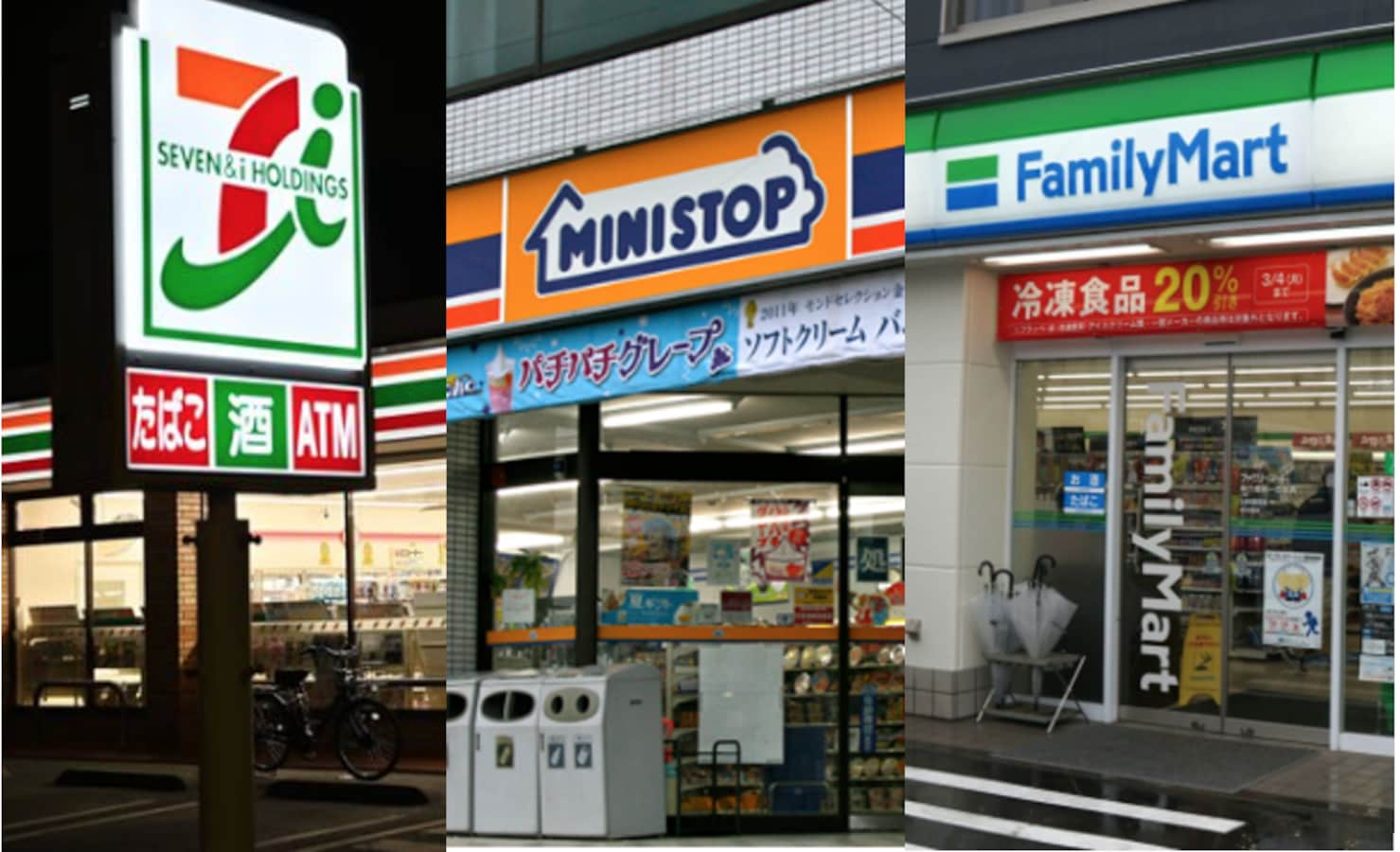
7-Eleven Japan (セブン‐イレブン・ジャパン)
Seven-Eleven Japan is the largest convenience store operator in Japan with over 21,000 domestic stores and arguably the strongest brand recognition of any retail format in the country. Its parent company, Seven & i Holdings, is one of Japan's largest retail conglomerates.
Franchise contract types:
7-Eleven Japan offers two primary contract formats:
Type A: The franchisee does not own or provide the land or building. Seven-Eleven Japan procures the site and leases the fully equipped premises to the franchisee. The franchisee's initial investment is primarily the opening deposit and initial inventory. The charge rate is higher under Type A contracts because the franchisor carries the real estate cost risk.
Type B / C: The franchisee owns or provides the land or building. The charge rate is lower in recognition of the franchisee's property contribution, but the franchisee bears full property ownership or lease costs.
Initial investment range (Japan domestic, 2026):
Type A contracts: approximately ¥1 million–¥3 million in opening deposit plus initial inventory and working capital
Franchisor provides store fit-out, equipment, and initial inventory on credit in most cases
Charge (royalty) rate: Approximately 43%–76% of gross profit, varying by contract type and store performance tier. Seven-Eleven's charge structure is tiered — stores with higher gross profit pay a higher absolute charge but may receive a lower effective rate. Multi-store operators (franchisees running 2 or more stores for over 5 years) receive a 3% incentive on the charge for additional stores.
Contract term: Approximately 15 years
Franchisor support: Among the strongest SV support networks in the industry. Seven-Eleven Japan's SV system assigns a dedicated consultant to each franchise who visits multiple times per week — more frequently than competitors — and provides detailed operational guidance.
Reality check: Seven-Eleven Japan has the most locations and the highest brand equity, but it also has the most demanding standards, the most prescriptive operational requirements, and historically the least franchisee flexibility on operating hours and product ordering. The legal and media coverage around franchisee working conditions — including the high-profile 2019 case of a Higashi-Osaka franchisee who was sued for ¥17 million for unilaterally reducing hours due to staff shortages — illustrates the power imbalance in the franchisor-franchisee relationship. The Japan Fair Trade Commission (JFTC) subsequently revised its Franchise Guidelines in 2021 to address some of the most egregious practices, including the inability to negotiate reduced hours and forced product ordering. Conditions have improved, but the relationship remains structurally weighted toward the franchisor.
Applicant profile sought: Seven-Eleven Japan actively recruits franchisees aged 40–65 in many of its campaigns, with particular interest in couples who can share the operational burden. Prior retail management experience is valued but not required. Willingness to operate the store personally (as owner-operator rather than absentee investor) is expected.
FamilyMart (ファミリーマート)
FamilyMart is Japan's second-largest chain with over 16,700 domestic stores. Majority-owned by Itochu Shoji, FamilyMart has been the most proactive of the major chains in actively addressing franchisee recruitment challenges in the face of Japan's demographic decline.
Key 2024–2026 development: FamilyMart launched a new franchise system that allows individuals with absolutely no prior convenience store experience to become franchisees — the first major chain to do so. This represents a significant cultural shift in how FamilyMart approaches recruitment and signals that the chain is actively adapting to labor market realities rather than waiting for ideal candidates.
Franchise contract structure: FamilyMart offers several contract variants including Type FC (franchisee provides store premises) and Type FC-S (FamilyMart provides the store premises). As with 7-Eleven Japan, the charge rate is higher when the franchisor provides the location.
Initial investment range:
Opening deposit: approximately ¥1.5 million–¥3 million depending on contract type
FamilyMart has a financial assistance system for qualified applicants who do not have the full opening capital upfront
Charge rate: Broadly comparable to Seven-Eleven Japan — calculated on gross profit, with rates varying by contract type and store performance
Contract term: Approximately 10–15 years depending on contract type
Post-opening support: FamilyMart's recruitment materials emphasize enhanced support for new franchisees during the first months of operation, including more intensive SV visits and training support. The chain has invested in digital tools to reduce the manual burden of tasks like product ordering and staff scheduling.
Applicant process: FamilyMart holds open information sessions (説明会) in major cities throughout the year. Attendance at an information session is typically the first formal step. After that, the process involves individual consultations, a financial assessment, a background and credit review, and a matching process to identify available store locations.
Reality check: FamilyMart's proactive recruitment posture is partly a response to the franchisee shortage that has emerged as older owners retire and fewer candidates emerge to replace them — a structural problem the industry as a whole faces as Japan's population ages. FamilyMart is opening its doors wider, which creates opportunity, but the underlying operational demands of running a store — the hours, the labor management, the compliance burden — have not changed.
Lawson (ローソン)
Lawson is Japan's third-largest chain by store count (approximately 14,600 domestic stores) but the most profitable convenience store operator in Japan for the past two consecutive years. Partially acquired by telecommunications and technology giant KDDI (which purchased a 50% stake from Mitsubishi Corporation in 2024), Lawson is the most technologically ambitious of the three major chains and has recently invested most heavily in retail media and smart store technology.
Franchise contract structure: Lawson uses a similar gross profit charge system to its competitors. Its contract variants include standard area franchise agreements and sub-franchise arrangements in some regions.
Key 2026 positioning: Lawson's "Real×Tech Convenience" store concept — featuring digital signage, AI-powered inventory management, and enhanced fresh food programs — is being piloted at selected locations and rolled out progressively. Franchisees who sign with Lawson in 2026 are entering a chain that is investing substantially in store-level technology. The benefit is operational support; the evolving complexity is something franchisees need to be comfortable managing alongside their existing responsibilities.
Applicant process: Similar to FamilyMart — information sessions followed by individual consultations and location matching. Lawson also runs regional franchise fairs that provide an efficient way to meet multiple franchise representatives at once.
Reality check: Lawson's positioning as the "health station" chain — with its emphasis on fresh produce, nutritional labeling, and premium food lines — gives its stores a slightly differentiated positioning in the market. For franchisees in areas with health-conscious demographic profiles, this positioning can be a genuine competitive advantage.
Step 5: How to Apply for a Franchise — The Process

Regardless of which chain you approach, the application process follows a broadly similar structure. Here is what to expect.
Phase 1: Initial Information and Self-Assessment
Every major chain holds regular information sessions (加盟説明会) in major cities. Attending is free and non-committal. The sessions cover the chain's franchise system, the contract structure, the financial model, and the support offered. They are typically conducted in Japanese, though some chains can arrange bilingual support for foreign applicants at the consultation stage.
Before attending, be honest with yourself about three things: your capital position (can you meet the ¥30 million Business Manager Visa threshold and the chain's opening deposit?), your Japanese language ability (N2 level is now a formal visa requirement, and operational fluency is a practical necessity), and your personal commitment to being physically present in the store during the early months and beyond. Franchisors assess all three.
Phase 2: Individual Consultation
Following the information session, you will have a one-on-one consultation with a franchise recruiter. This is the stage where the recruiter assesses you as a candidate and begins the process of understanding your background, motivations, capital position, and location preferences. Come prepared with:
A clear explanation of your business background and any relevant retail or management experience
Documentation of your financial position — bank statements, proof of assets
Your visa status and its implications for the Business Manager Visa application
Your preferred location or geographic area for the store
Be straightforward about being a foreign national. The major chains have had foreign franchisees in the past and have a framework for it, but they will need to understand your visa path and confirm that the Business Manager Visa requirements are being met. Bringing a bilingual advisor to this meeting is worthwhile if your Japanese is not yet at the level required for confident business discussions.
Phase 3: Financial Assessment and Background Check
The franchisor will conduct a financial assessment to verify that you have the capital required to meet the opening deposit and working capital needs, and a background check covering your credit history and any prior business or legal history. Be transparent — discrepancies discovered later in the process will disqualify an application.
Phase 4: Location Matching
This is one of the least-understood aspects of becoming a konbini franchisee. You do not simply choose your own location. The franchisor maintains a database of available stores — either existing stores that need a new franchisee due to contract expiry or owner retirement, or new sites the chain has identified as viable for development. Your role in location selection is to indicate your geographic preferences; the actual location is proposed by the franchisor based on what is available in your area.
In some cases — particularly in sought-after urban locations — you may face limited options or a waiting period. In less competitive regional markets, available locations may be more numerous. Discuss location options openly with the recruiter from the first consultation.
Phase 5: Training Program
Before opening, all franchise owners complete a mandatory training program covering store operations, product ordering, food safety management, staff management, and the POS system. Training duration varies by chain but typically runs four to eight weeks. Training is conducted in Japanese. If your Japanese is not yet operational-level fluent, you will need either to improve it substantially or to have a trusted Japanese-speaking partner complete the training alongside you.
Training is not optional and cannot be abbreviated. The chains invest significantly in ensuring franchisees can actually run a store before they hand over the keys. Respect the process — it exists because the operational complexity of a konbini is genuinely high.
Phase 6: Contract Signing
The franchise agreement is a long, detailed legal document in Japanese. It governs every aspect of the franchise relationship for the duration of the contract term — typically 10 to 15 years. Review it carefully, ideally with a bilingual lawyer who has franchise experience. Key clauses to understand:
The exact charge rate and how it is calculated
What the franchisor's obligations are — and what remedies you have if they are not met
The 24-hour operating hours clause and what conditions permit deviation
Product ordering obligations and your rights regarding product mix
What happens if you want to close, sell, or transfer the franchise
Renewal terms at contract expiry
Dispute resolution mechanisms
The 2021 revision of the JFTC's Franchise Guidelines improved franchisee protections on several important points — including the right to negotiate reduced operating hours without facing automatic contract termination — but the franchisor still retains substantial control over the relationship. Know what you are agreeing to.
Step 6: Required Licenses and Permits

Running a convenience store in Japan requires several licenses regardless of whether you are operating under a franchise or independently. As the store owner, you — not the franchisor — are the license holder responsible for compliance.
Food Business License (飲食店営業許可 or 食料品販売業許可)
For stores that sell prepared food for immediate consumption (heated items, fresh food, hot coffee), a food business license from the local public health center (保健所, hoken-jo) is required. This requires a Food Sanitation Manager to be designated and registered.
Major chain franchisors will guide you through this process as part of the store opening procedure — but you are the applicant and the responsible party.
Food Sanitation Manager Certificate (食品衛生責任者)
Every food retail or food service establishment in Japan must designate at least one Food Sanitation Manager — an individual who has completed the mandatory one-day training course run by the prefectural food sanitation association. This can be you, the head employee, or any full-time designated staff member. The training is in Japanese, non-examination based (attendance is the requirement), and costs approximately ¥10,000–¥12,000. Book early — courses fill quickly in major cities.
Alcohol Sales License (酒類販売業免許)
Selling alcohol for off-premises consumption — which includes every bottle, can, and carton of beer, wine, and spirits on a konbini shelf — requires an Alcohol Sales License from the Regional Tax Office (税務署). This is distinct from the restaurant alcohol permit that covers on-premises drinking.
For a franchise store, the franchisor typically assists with the application process, but the license is issued in the franchisee's name and is the franchisee's legal responsibility. Processing takes approximately two months from application to issuance — this timeline must be factored into your opening schedule.
Tobacco Retail Sales Authorization (たばこの小売販売業の許可)
Cigarettes are a meaningful revenue contributor for konbini. Selling tobacco products requires authorization from the Japan Tobacco International retail licensing process. New authorizations are only issued when the nearest existing authorized tobacco retailer exceeds a minimum distance threshold — an anti-competitive protection for existing retailers. Your franchisor will assess whether your location qualifies and assist with the application if it does.
Fire Prevention Manager (防火管理者)
For stores with a total floor area over 300 m² (most standalone konbini buildings qualify), a Fire Prevention Manager designation and a fire prevention management plan submitted to the local fire department are required. The Fire Prevention Manager qualification is obtained through a one or two-day training course (Class A or Class B depending on facility size) at a cost of approximately ¥5,000–¥8,000.
Summary: License Timeline
License | Issued By | Processing Time | Notes |
|---|---|---|---|
Food Sanitation Manager | Prefectural food sanitation association | 1 day (training attendance) | Must be designated before food business license issued |
Food Business License | Local public health center | 1–2 weeks post-inspection | Apply 10+ days before opening |
Alcohol Sales License | Regional tax office (税務署) | ~2 months | Apply well in advance of target opening |
Tobacco Retail Authorization | Japan Tobacco licensing | Varies | Distance rule applies; franchisor assists |
Fire Prevention Manager | Fire department training provider | 1–2 days (training) | Required before opening if facility qualifies |
Fire prevention plan submission | Local fire department | Immediate submission | Submit before opening |
Step 7: Real Financials — What Franchisees Actually Earn

This is the section that franchise recruiters are least likely to share with you upfront, and the section that matters most for your decision.
Revenue and Gross Profit Benchmarks
A well-located, well-managed convenience store franchise in Japan generates annual net sales in the range of ¥150 million to ¥300 million. Gross profit (after cost of goods sold, shrinkage, and disposal losses) typically represents approximately 30%–33% of net sales, giving a gross profit range of ¥45 million to ¥100 million annually for a performing store.
The franchisor's charge — at rates of roughly 43%–76% of gross profit depending on contract type and performance — takes a significant portion of that gross profit. Remaining gross income (franchisee's share of gross profit after the charge) might range from ¥20 million to ¥55 million annually for a strong store, before any operating expenses.
Operating Expenses the Franchisee Bears
From the franchisee's gross income share, deduct:
Staff wages: The largest cost by far. A 24-hour store typically requires 15–25 part-time staff (アルバイト, arubaito) plus potentially a store manager. At Tokyo's minimum wage of ¥1,163 per hour (late 2025) and typical shift coverage requirements, annual labor costs easily reach ¥15 million–¥25 million for a fully staffed store.
Utilities: The franchisor provides an electricity subsidy but does not cover full utility costs. Net utility costs to the franchisee are typically ¥2 million–¥4 million annually.
Insurance: Store contents, public liability, and other coverage — approximately ¥500,000–¥1 million annually.
Miscellaneous operating costs: Cleaning, waste disposal, minor repairs, uniforms — ¥500,000–¥1 million annually.
Net Monthly Income Reality
After all deductions, the average monthly net income for a Japanese konbini franchisee — including those operating as a couple or with family involvement — has been reported at approximately ¥500,000 per month (approximately ¥6 million per year). This figure represents the middle of the distribution; top-performing stores in excellent locations can significantly exceed this, while underperforming stores in saturated areas may fall well short.
That ¥500,000 monthly income comes at a price that goes beyond the financial: it typically requires the owner and partner to work extremely long hours, particularly during the early years when the business is being established and before a reliable part-time workforce is in place. Franchise owners who do not have a partner or family member sharing the management burden often report working 12–16 hours per day during critical periods.
The 24-Hour Operating Hours Question
The requirement to operate 24 hours a day, 365 days a year has been one of the most contentious issues in Japan's konbini franchise industry. The JFTC's 2021 revision to the Franchise Guidelines established that franchise headquarters cannot unilaterally refuse to even discuss reduced operating hours with a franchisee — doing so is now identified as a potential violation of the Antimonopoly Act's provisions against abuse of a superior bargaining position.
In practice, this does not mean you can simply choose to close from midnight to 6am. It means the franchisor is now required to negotiate in good faith if you raise the issue, rather than simply refusing. Whether the negotiation results in permission for reduced hours depends on the specific situation and the franchisor's assessment of the location.
For a foreign entrepreneur building their staffing plan and financial model, the 24-hour obligation must be treated as the default operating requirement — and staffed for accordingly — unless and until specific agreement on shorter hours is reached with the franchisor.
Step 8: Startup and Ongoing Costs

Initial Investment to Open a Major Chain Franchise
Cost Item | Type A Contract (Franchisor provides premises) | Type B/C (Franchisee provides premises) |
|---|---|---|
Opening deposit | ¥1,000,000–¥3,000,000 | ¥2,000,000–¥5,000,000 |
Initial inventory (partially financed) | ¥3,000,000–¥5,000,000 | ¥3,000,000–¥5,000,000 |
Working capital reserve | ¥2,000,000–¥5,000,000 | ¥2,000,000–¥5,000,000 |
License application fees | ¥100,000–¥300,000 | ¥100,000–¥300,000 |
Training period expenses | ¥200,000–¥500,000 | ¥200,000–¥500,000 |
Business Manager Visa application | ¥100,000–¥300,000 (professional fees) | ¥100,000–¥300,000 |
Company incorporation | ¥60,000–¥400,000 | ¥60,000–¥400,000 |
Total estimated initial cash outlay | ¥6,000,000–¥14,000,000 | ¥7,500,000–¥16,000,000 |
Note: The ¥30 million Business Manager Visa capital requirement is separate from and in addition to the operational cash outlay above. The ¥30 million is registered capital in your incorporated entity — it funds the business, but it is not all spent on the items in the table above. Think of it as the equity base of your company, from which operating costs, deposits, and working capital are drawn.
Financing: Japan Finance Corporation (JFC)
The Japan Finance Corporation is the most accessible institutional lender for foreign entrepreneurs starting a first business in Japan. Its new business startup loan products are available to foreign residents with valid work authorization and a credible business plan.
For a convenience store franchise application specifically, JFC loan assessments will focus on the franchise agreement terms, the location's projected revenue (which the franchisor can provide historical or estimated data for), your personal financial history, and your management experience. The franchise brand itself — particularly for one of the three major chains — is generally viewed favorably by JFC assessors as evidence of business viability.
Indicative JFC loan terms for a konbini franchise:
Loan amount: up to ¥20–¥30 million for a qualifying new startup loan
Interest rate: approximately 2%–3.5% base rate
Repayment term: 7–10 years with a 1–2 year grace period on principal
No collateral required for qualifying amounts
Prepare your JFC application in Japanese. Engage a bilingual accountant or business plan writer if your written Japanese is not at business level. The business plan must include detailed revenue projections, a cost breakdown, a management plan demonstrating your ability to run the store, and evidence of the franchise agreement in principle.
Step 9: Operating a Konbini — The Daily Realities

Understanding what you will actually do every day is as important as understanding the financials. Here is what owning and managing a Japanese convenience store actually looks like.
Staffing Is Everything
The most critical management task for a konbini owner is staffing. A typical 24-hour store needs 15–25 part-time workers to cover all shifts across a week, plus ideally one or two full-time or near-full-time staff in management-adjacent roles.
Recruiting part-time staff — primarily from the pool of local high school and university students, working adults wanting supplementary income, senior workers, and increasingly international residents on working holiday visas or student visas — is a constant activity. Japan's labor shortage is most acutely felt in exactly the kinds of roles a konbini requires: shift work, variable hours, physical retail tasks, minimum wage pay. In urban areas, competing with nearby restaurants, other chains, and delivery services for the same part-time workers is an ongoing challenge.
Schedule management, in particular, becomes a daily operational puzzle. Staff calling in sick for a shift in the middle of the night, difficulty finding replacements for early morning hours, and the challenge of maintaining consistent service quality with a rotating part-time workforce are realities that every franchisee deals with continuously. Digital scheduling tools — now provided by all three major chains — help, but they do not eliminate the human management challenge.
Staff management in Japan also requires careful attention to labor law. Minimum wage compliance, overtime rules, social insurance enrollment thresholds for part-time workers, and proper employment contracts are all legal obligations the franchisee must maintain. Labor inspection authorities enforce these rules, and violations carry penalties that can also damage the franchise relationship.
Product Ordering and Waste Management
A significant portion of a konbini owner's financial performance depends on product ordering accuracy. Fresh items — onigiri, bento, sandwiches, pastries — have a shelf life measured in hours. Ordering too much means disposal losses that reduce gross profit; ordering too little means empty shelves and missed sales.
The franchisor's ordering system provides data-driven recommendations based on historical sales patterns, local event calendars, and weather forecasts. Using these tools effectively — understanding when to follow the system's recommendations and when local knowledge suggests a different approach — is a skill that develops over time. Early in the franchise, leaning heavily on the SV's guidance while building your own intuition about your specific store's patterns is the practical approach.
Unsold food approaching expiry is a real financial cost. Japan's convenience store industry has faced significant criticism over food waste — millions of items are discarded daily across the network. The JFTC has addressed this, and the revised Franchise Guidelines now explicitly protect franchisees' right to discount near-expiry items to reduce waste rather than being required to sell at full price until disposal. This is a meaningful protection that translates directly into gross profit preservation.
The Supervisor (SV) Relationship
Your SV — the field consultant assigned to your store by the franchisor — is one of your most important business relationships. A good SV can significantly improve your store's performance through actionable guidance; a poor or inattentive one can leave you navigating problems alone.
The SV visits your store multiple times per week (more frequently at Seven-Eleven Japan, somewhat less at FamilyMart and Lawson) and reviews your ordering patterns, waste levels, staff scheduling, cleanliness scores, and financial performance. They also serve as your primary point of contact for issues with the franchisor's supply chain, technology systems, and support resources.
Maintain a professional, constructive relationship with your SV from day one. They have significant informal influence over how the franchisor views your performance and your franchise account — and when you need flexibility on something (an ordering adjustment, a request to discuss operating hours), that relationship is your channel.
Technology Integration in 2026
Japan's konbini are among the most technology-intensive retail environments in the world. As of 2026:
AI-assisted ordering systems are standard across all three major chains
Self-checkout terminals are being progressively installed across franchise networks
Digital signage (in-store advertising screens) is being rolled out across Seven-Eleven and Lawson stores
Cashless payment — IC cards, smartphone apps, QR code payments — accounts for a growing majority of transactions
Staff scheduling apps and shift management tools are integrated into the store management platform
For a foreign owner, these tools are helpful — they reduce some of the operational burden and provide data that would otherwise require manual tracking. They also require learning and ongoing familiarity. The training program covers the core systems, and the SV provides ongoing support, but staying current with system updates and new features is an ongoing responsibility.
Step 10: Honest Assessment — Is This the Right Business for You?

This is the section that a franchise recruiter will not write. Before committing to a 10–15 year franchise contract and the substantial capital and personal commitment it requires, answer these questions honestly.
Do you have functional Japanese at or above JLPT N2? Not "I can get by," but genuinely able to manage staff meetings, negotiate with suppliers, understand your SV's operational feedback, and read a franchise agreement. If the answer is not yet, commit to achieving this before applying, not while you are running the store.
Are you prepared for the physical and time demands? The data on franchisee working hours is unambiguous. The early period of a new store — before your staffing is reliable and your routines are established — involves very long days. If your expectation is a business where you can be largely absent while managers run things, the konbini model does not work that way, particularly at the beginning.
Is your capital position genuinely solid? The ¥30 million Business Manager Visa requirement plus the opening deposit, working capital, and the buffer for the first months of lower-than-expected revenue is a substantial commitment. Going in undercapitalized is the fastest route to crisis.
Have you honestly assessed the market in your target location? Visit the location you are being offered at different times of day and night. Count foot traffic. Walk into the nearest competing konbini and assess how busy it is. Talk to the local ward office about population trends in the neighborhood. A location that looked promising to the franchisor's site team may look different to someone who will live or die by that store's daily sales.
Are you in Japan for the long term? A 10–15 year franchise contract is a serious commitment to Japan. If there is meaningful uncertainty about whether you will still be in Japan in five years, a konbini franchise is not the right vehicle for your business energy.
If the honest answers to all of these questions are positive — the konbini franchise model in Japan can provide stable, respectable income, deep integration into your local community, and a business with the kind of institutional support and brand infrastructure that takes decades to build from scratch. For the right person, in the right location, with the right preparation, it works.
Frequently Asked Questions
Can I become a konbini franchisee without speaking Japanese? Not practically, and not legally under the October 2025 Business Manager Visa rules. The visa now requires JLPT N2 from either you or a qualifying full-time employee. Operationally, managing staff, communicating with your SV, ordering products through Japanese systems, and dealing with licensing authorities all require functional Japanese. The franchisor's training program is also in Japanese. This is a hard requirement, not a soft recommendation.
Can I own multiple stores? Yes. Multi-store ownership is actively encouraged by all three major chains as a solution to the franchisee shortage problem. Seven-Eleven Japan offers a charge incentive for second and subsequent stores for franchisees who have operated successfully for over five years. The management challenge scales with each additional store — you will need a reliable management team in place at existing stores before taking on a second location.
Is the 24-hour requirement negotiable? Under the revised JFTC Franchise Guidelines, the franchisor must negotiate in good faith if you raise the issue of reduced hours — it cannot simply refuse to discuss it. Whether your specific store is approved for reduced hours depends on the franchisor's assessment of the location and the circumstances. Treat full 24-hour operation as the baseline requirement in your planning.
What happens if I want to exit the franchise before the contract expires? Early termination of a konbini franchise contract is costly and contractually complex. Penalties for early exit vary by chain and contract type but can be substantial. In some cases, finding a buyer for the franchise is possible — the chains generally allow franchise transfers to approved new owners, which avoids penalties. Review the exit clauses with a lawyer before signing any franchise agreement.
Can I use the konbini franchise as a path to permanent residency? Not directly. Owning a business does not grant immigration status independently of your visa category. The Business Manager Visa does count toward the continuous residence period required for permanent residency (10 years standard, or faster under the HSP points system). As long as your business is genuinely active and your visa remains in good standing, you accumulate qualifying residence time — but the business itself is not a separate pathway.
Will the franchisor help me with the Business Manager Visa application? The major chains have experience with foreign franchisees and their staff can provide documentation of the franchise agreement and projected financial performance that supports a Business Manager Visa application. However, the visa application is your responsibility — the franchisor is not an immigration advisor and cannot guarantee visa outcomes. Engage an immigration specialist to manage the application.
Quick Reference Summary
Topic | Key Information |
|---|---|
Market size | ¥13.5 trillion annual sales; 56,000+ stores nationwide |
Primary visa route | Business Manager Visa (post-Oct 2025: ¥30M capital, qualifying employee, JLPT N2) |
Preparation alternative | Startup Visa — up to 2 years to prepare before Business Manager Visa |
Franchise options | 7-Eleven Japan (~21,000 stores), FamilyMart (~16,700), Lawson (~14,600) |
Royalty structure | Charge on gross profit (~43%–76% depending on contract type and chain) |
Contract term | 10–15 years |
Average franchisee monthly income | ~¥500,000 (after staff wages and operating costs) |
Initial cash outlay | ¥6M–¥16M (excluding ¥30M visa capital requirement) |
Key licenses | Food business license, Food Sanitation Manager, Alcohol Sales License, Tobacco authorization, Fire Prevention Manager |
24-hour requirement | Default obligation; negotiable in good faith under 2021 JFTC guidelines |
Biggest operational challenge | Staffing — recruiting and retaining reliable part-time workers |
JFC loan access | Available; approximately 2%–3.5% rate, up to ¥30M for qualifying applicants |
Language requirement | JLPT N2 (visa requirement); operational Japanese essential regardless |
Japan's konbini industry is not the gold rush it once appeared. The era of simply securing a good location and watching the profits flow is long past. What remains is a genuine business opportunity for entrepreneurs who go in fully informed, properly capitalized, linguistically prepared, and personally committed to the operational demands of running a store that serves its community 24 hours a day. For those who meet that bar, the institutional framework of a major chain franchise — the brand, the supply chain, the technology, the SV support — provides a business foundation that takes decades and hundreds of millions of yen to build from scratch. Use it wisely, manage it well, and it can be a rewarding and stable long-term business in one of the world's most interesting markets.
Read next
How to Start a Restaurant as a Foreigner in Japan: The Complete 2026 Guide
Continue with a related guide to keep your reading momentum.
Comments
No approved comments yet.